


We verify insurance coverage and authorization requirements before services are rendered, helping practices reduce eligibility-related denials and avoid reimbursement delays.
Insurance Eligibility Verification — Verify active/inactive coverage, effective dates, payer and plan details.
Benefits Verification — Check copay, deductible, coinsurance, out-of-pocket responsibility, visit limits, and benefit coverage.
Network & Service Coverage — Confirm in-network/out-of-network status, covered services, exclusions, and limitations when available.
Prior Authorization Requirements — Identify whether the planned procedure/service requires prior authorization or precertification.
Authorization Submission — Submit required patient, provider, procedure, diagnosis, and supporting clinical information to the payer.
Authorization Follow-Up — Track pending authorization requests, communicate with payers, and follow up until a determination is received.
Authorization Tracking — Record authorization numbers, approved CPT/service details, effective dates, units/visits approved, and expiration dates.
Issue Identification — Flag coverage discrepancies, authorization issues, missing information, and benefit limitations before the services rendered.
Eligibility Verification & Prior Authorization
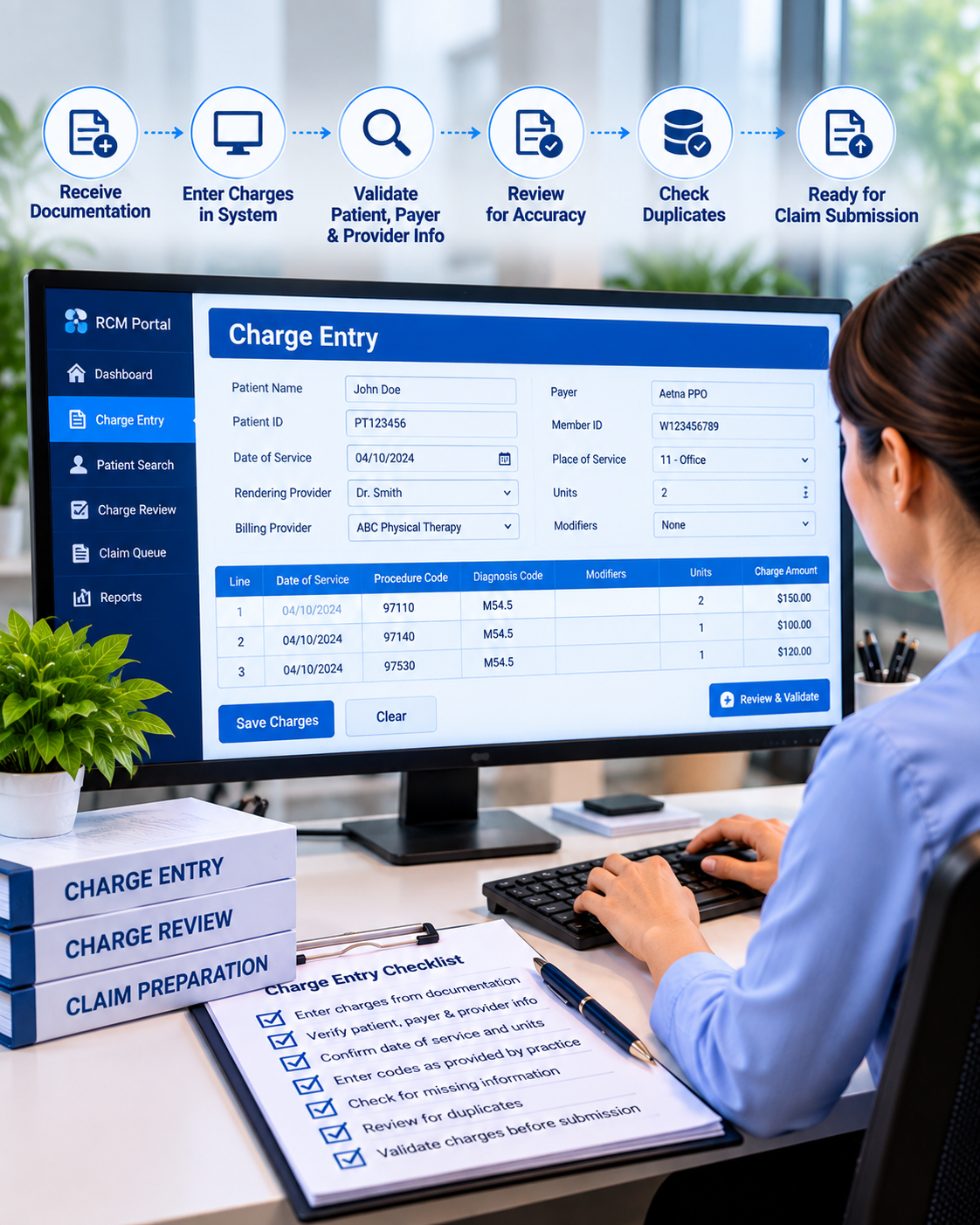
Accurate and timely charge entry helps ensure services rendered are properly captured and prepared for claim submission. Our team enters charges based on the information provided by the practice and performs key checks before moving the claim forward.
Charge Capture — Enter charges for documented services into the billing system.
Patient & Insurance Validation — Confirm the correct patient, payer, and insurance information is associated with the charge.
Provider Information — Verify the appropriate rendering and billing provider information.
Service Details — Enter the date of service, place of service, units, modifiers, and other billing information as provided by the practice.
Code Entry — Enter CPT/HCPCS and diagnosis codes provided by the practice; Karmic RCM does not independently perform medical coding.
Charge Review — Check for missing or incomplete billing information before claim creation.
Duplicate Charge Check — Help identify duplicate entries before submission.
Timely Charge Entry — Process charges promptly to help avoid unnecessary billing delays.
Charge Entry / Claims Submission
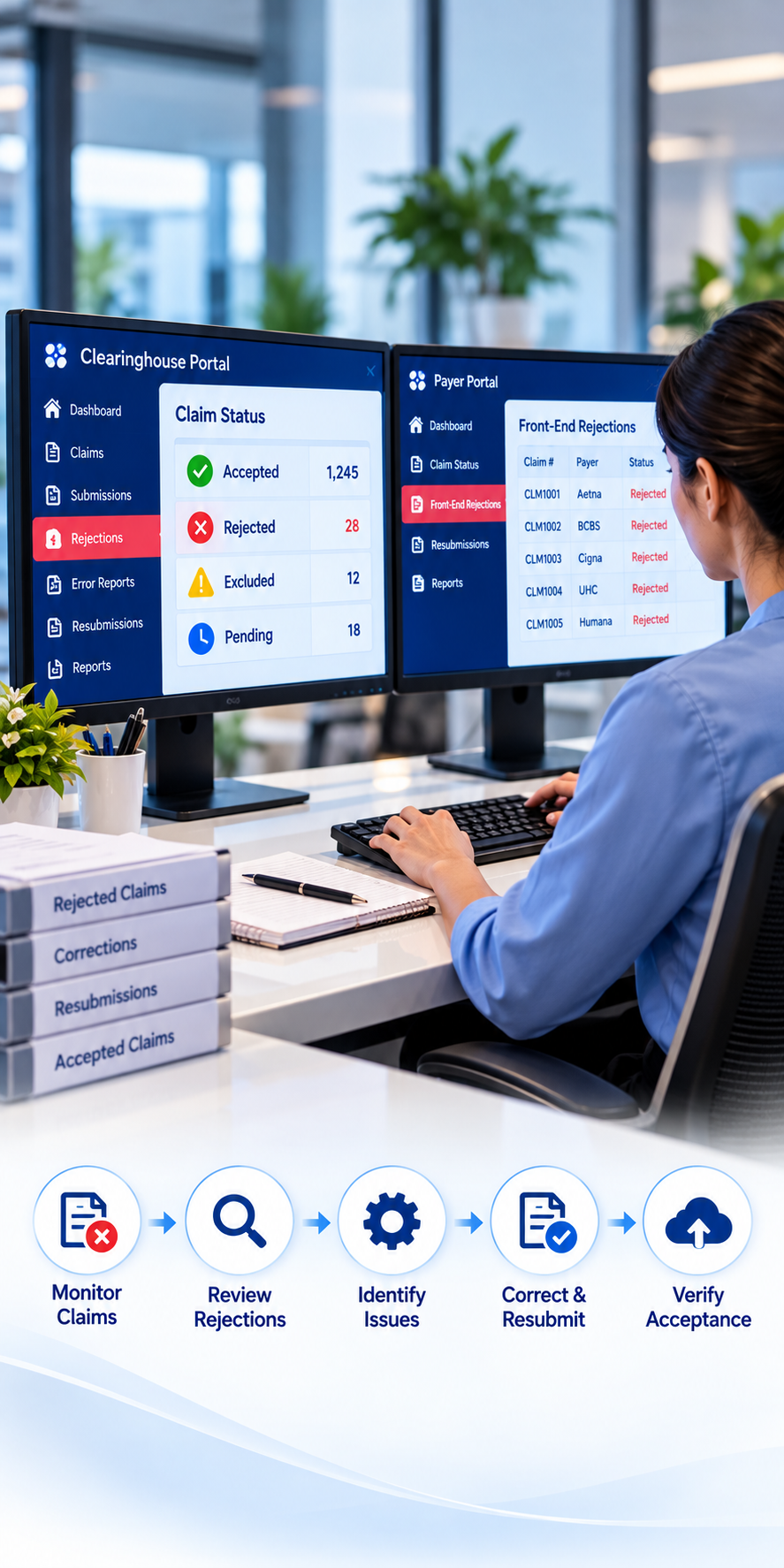
Timely management of claim rejections is critical to preventing avoidable delays in reimbursement. At Karmic RCM, we actively monitor claims after submission through the clearinghouse and review both clearinghouse-level and payer-level/front-end rejections. Our team identifies actionable issues, makes corrections within our scope, resubmits claims, and verifies successful acceptance. We target actionable rejections for review and resolution within 24 hours of identification, while promptly escalating items that require additional information from the practice or payer.
Clearinghouse Monitoring — Monitor submitted claims to identify accepted, rejected, excluded, or errored claims before they remain unresolved in work queues.
Clearinghouse Rejection Review — Review rejection messages and reports to determine the reason a claim did not successfully pass clearinghouse edits.
Exclusion & Error Queue Management — Work exclusion reports, error queues, and failed claim submissions to identify claims requiring correction or additional information.
Payer-Level / Front-End Rejections — Monitor claims that successfully pass the clearinghouse but are subsequently rejected at the payer's front-end or gateway before adjudication.
Rejection Analysis — Identify actionable rejection causes such as patient or subscriber information, insurance details, payer information, provider/NPI information, claim formatting, missing required fields, invalid or incomplete data, and other submission-related issues.
Correction & Resubmission — Correct rejection issues that fall within Karmic RCM's billing scope and resubmit claims promptly for processing.
24-Hour Rejection Turnaround — Target actionable clearinghouse and payer-level rejections for review and resolution within 24 hours of identification, helping prevent rejected claims from aging unnecessarily.
Practice Escalation — Promptly communicate issues requiring additional documentation, corrected information, coding clarification, or action from the practice rather than allowing the claim to remain unresolved.
Resubmission Tracking — Track corrected and resubmitted claims to ensure they successfully move through the clearinghouse and payer intake process.
Acceptance Verification — Confirm that corrected claims have been accepted by the clearinghouse and/or payer and have progressed to adjudication.
Rejection Trend Monitoring — Identify recurring rejection patterns and communicate trends that may help the practice reduce preventable errors on future claims.
Clearinghouse & Rejection Management

Effective claim follow-up is essential to maintaining healthy cash flow and preventing outstanding claims from aging unnecessarily. Once claims are accepted by the clearinghouse and payer, Karmic RCM actively monitors claim status, follows up on outstanding balances, identifies processing delays, and takes appropriate action to move claims toward resolution.
Claim Status Monitoring — Track claims through payer adjudication to identify received, in-process, pending, paid, denied, or action-required statuses.
A/R Aging Review — Review outstanding insurance balances across 0–30, 31–60, 61–90, 91–120, and 120+ day aging buckets and prioritize accounts requiring attention.
Payer Portal Follow-Up — Utilize payer portals and available electronic claim-status tools to obtain current processing information and identify required actions.
Payer Follow-Up — Contact insurance payers when necessary to investigate delayed, pending, or unresolved claims and determine the next appropriate action.
Pending Claim Management — Monitor claims that remain under payer review or processing and perform follow-up based on applicable payer processing timeframes.
Additional Information Requests — Identify requests for medical records, supporting documentation, corrected information, or other payer requirements and coordinate with the practice for timely response.
Unprocessed & No-Response Claims — Investigate claims with no clear payer response or adjudication and initiate appropriate follow-up.
Timely Filing Monitoring — Monitor outstanding claims and filing deadlines to help minimize avoidable losses associated with timely filing limits.
Follow-Up Documentation — Maintain detailed notes including payer responses, reference numbers, actions taken, claim status, next steps, and follow-up dates.
Practice Escalation — Promptly escalate accounts requiring provider documentation, medical records, coding clarification, enrollment information, or other practice-level action.
Resolution Tracking — Continue appropriate follow-up until a defined outcome is reached, such as payment, denial, adjustment, corrected claim, appeal requirement, or another documented action.
Claims Status & A/R Follow-Up
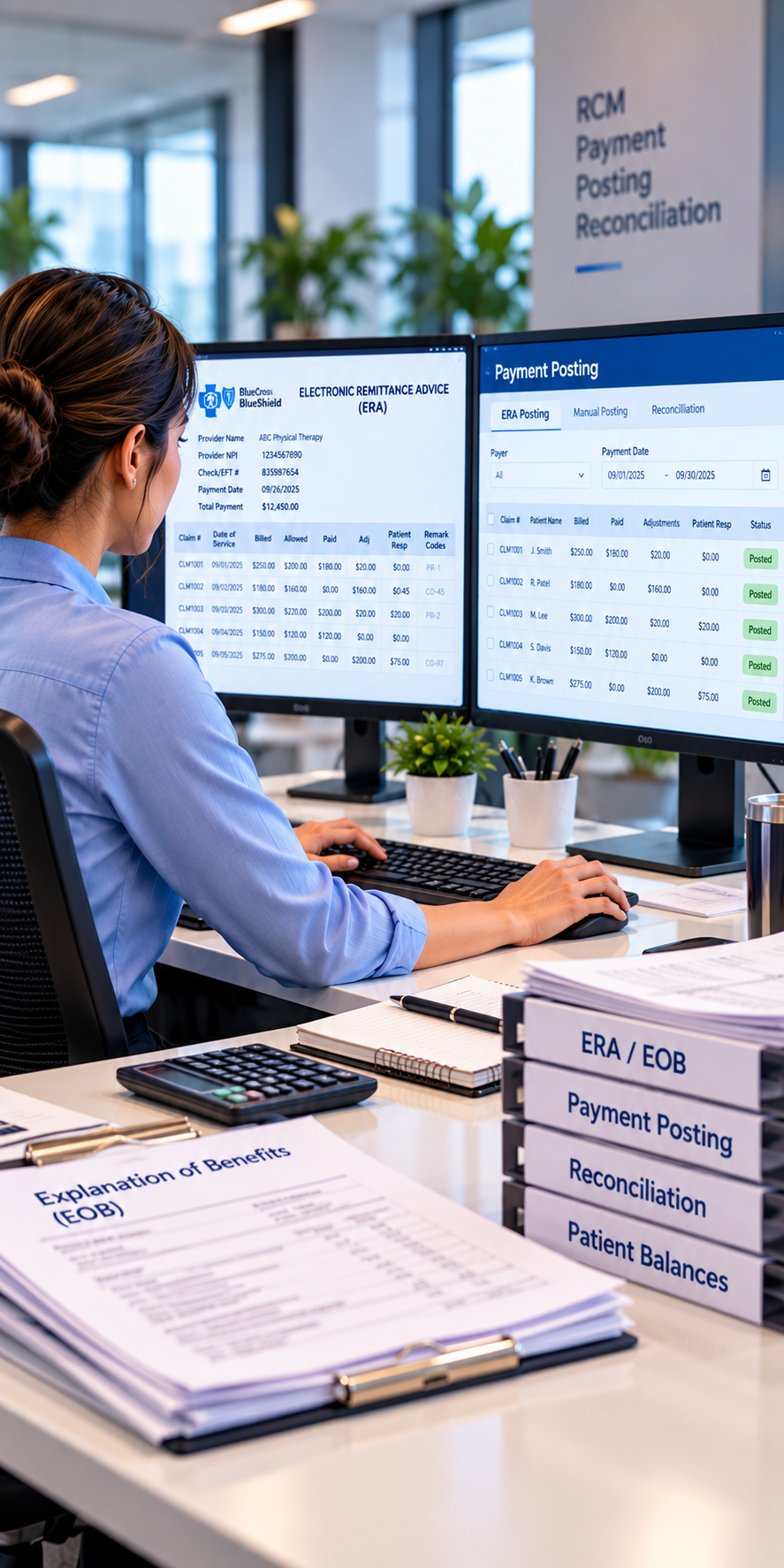
Accurate payment posting is essential for maintaining reliable patient account balances and a clear picture of a practice’s accounts receivable. Karmic RCM carefully reviews payer remittance information and accurately posts insurance payments, adjustments, and patient responsibility to the appropriate accounts. Our process helps ensure that payments are properly applied, discrepancies are identified, and accounts are moved to the appropriate next step for follow-up.
ERA & EOB Review — Review Electronic Remittance Advice (ERA) and Explanation of Benefits (EOB) information received from insurance payers before posting payments and adjustments.
Insurance Payment Posting — Accurately post payer payments to the appropriate patient account, claim, date of service, and service line based on the remittance information.
Patient Responsibility Posting — Apply payer-assigned amounts such as deductibles, copays, coinsurance, and other patient responsibility to the appropriate patient balance.
Contractual Adjustment Posting — Post applicable contractual adjustments and payer-approved write-offs according to the ERA/EOB and established practice guidelines.
Electronic & Manual Payment Posting — Process ERA-based payments as well as applicable manual EOB/payment information to maintain accurate account balances.
Payment Reconciliation — Compare posted payments with the corresponding ERA/EOB and payment information to help ensure amounts are accurately accounted for.
Underpayment & Payment Variance Identification — Identify potential underpayments, unexpected reductions, zero payments, or payment discrepancies that may require additional review or payer follow-up.
Denial Identification — Identify denied or non-paid claim lines during payment posting and route them to the appropriate Denial Management workflow rather than allowing them to remain unresolved.
Unapplied & Unidentified Payment Review — Research payments that cannot immediately be matched to the correct patient, claim, or service line and work toward proper allocation.
Accurate Balance Updates — Ensure insurance and patient balances are appropriately updated after payments, adjustments, and patient responsibility are posted.
Posting Quality Review — Perform checks to help identify incorrect payment allocation, duplicate posting, missing adjustments, or balance discrepancies.
Timely Payment Posting — Process available remittance and payment information promptly so the practice's A/R and financial reporting remain current and accurate.
Payment Posting & Reconciliation

Denied claims can significantly impact reimbursement when they are not identified and addressed promptly. Karmic RCM systematically reviews payer denials, identifies the reason for non-payment, determines the appropriate next action, and works each actionable denial toward resolution. Our team focuses not only on resolving individual denials but also on identifying recurring patterns that may help reduce preventable denials in the future.
Denial Identification & Review — Review denied and non-paid claims identified through ERA/EOBs, payer portals, and claim-status follow-up to determine the reason for denial.
CARC & RARC Review — Analyze Claim Adjustment Reason Codes (CARCs) and Remittance Advice Remark Codes (RARCs) along with payer explanations to understand the specific reason for non-payment.
Denial Categorization — Organize denials by reason, such as eligibility, authorization, coverage, timely filing, duplicate claims, medical necessity, coding-related issues, provider information, coordination of benefits, or missing documentation.
Root-Cause Analysis — Investigate the underlying cause of recurring denials to determine where issues are occurring within the revenue cycle.
Corrected Claim Processing — When appropriate and within our scope, correct billing or claim information and submit a corrected claim according to payer requirements.
Reconsideration & Appeal Support — Prepare and submit reconsiderations or appeals when appropriate, using available claim information and supporting documentation provided by the practice.
Documentation Coordination — Identify payer requests for medical records, authorization information, clinical documentation, or other supporting documents and coordinate with the practice to obtain the required information.
Payer Follow-Up — Follow up with payers after corrected claims, reconsiderations, or appeals are submitted to monitor status and identify additional requirements.
Appeal Deadline Monitoring — Track applicable reconsideration, appeal, and timely filing deadlines to help prevent avoidable loss of reimbursement opportunities.
Denial Resolution Tracking — Maintain documentation of actions taken, payer responses, reference numbers, submission dates, follow-up dates, and final outcomes.
Denial Trend Analysis — Monitor recurring denial reasons and communicate meaningful trends to the practice to support improvements in upstream processes.
Denial Management & Appeals

Clear and consistent reporting gives practices better visibility into the financial performance of their revenue cycle. Karmic RCM provides actionable RCM reports and performance insights to help practices understand outstanding receivables, payment activity, claim issues, denial trends, and areas requiring attention. Our reporting focuses on turning day-to-day billing activity into meaningful information that supports better revenue-cycle decisions.
A/R Aging Reports — Provide visibility into outstanding insurance receivables across aging categories such as 0–30, 31–60, 61–90, 91–120, and 120+ days.
Claims Status Reports — Track outstanding claims by payer, status, age, and follow-up activity to provide visibility into claims still awaiting resolution.
Payment & Collection Reports — Summarize insurance payments, posted amounts, adjustments, and overall collection activity for the reporting period.
Denial Analysis — Report on denial volumes, denial reasons, payer trends, and recurring issues to help practices understand where reimbursement is being affected.
Rejection Analysis — Monitor clearinghouse and payer front-end rejection trends, including recurring rejection reasons and correction activity.
Payer Performance Insights — Review patterns such as processing delays, outstanding balances, denials, and payment activity by payer to identify areas requiring closer attention.
Outstanding A/R Review — Highlight high-dollar, aged, pending, and unresolved claims that may require additional follow-up or escalation.
Authorization & Eligibility Trends — Where applicable, identify recurring issues involving eligibility, benefits, authorization requirements, or authorization-related denials.
Revenue Cycle Performance Tracking — Monitor relevant operational indicators such as A/R aging, claim resolution activity, rejection trends, denial trends, and payment activity over time.
Practice-Level Reporting — Provide organized reports that give the practice a clear view of what has been worked, what remains outstanding, and what requires practice attention.
Actionable Insights — Highlight recurring issues and trends discovered through RCM operations so the practice can address potential problems earlier in the revenue cycle.